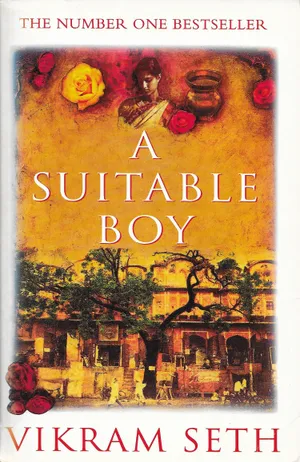
That mammoth of a book was pleasure to read and in the same time great exercise for my arm after accident.
The novel is like intricate fabric, with multiple threads weaving around each other and displaying fine lavishly ornamented whole. On the face of it and with heavy impression from the title itself, it is a story of Lata Mehra and her mother, in 1951 freshly independent India, trying to find “a suitable boy” for Lata. Not surprising though, given the size of the story, it is as much story of her extended family and even more so of turbulent times of new India trying to find itself.
The main setting is fictional state Purva Pradesh and its capital Brahmpur. Although fictional, it is firmly located in Hindi heartland and Brahmpur laying along Ganga. It brings to mind central and north Indian states, Purva Pradesh being somewhat mix of various states without committing to accurate history depiction. It allows the story to present it as microcosm of fate of the country with it’s common problems after the Partition. As a social scenery we have plethora of issues and events. There are Muslim-Hindu tensions, both in parliament debate and in protests and riots. Political fight for abolishment of feudal system and then related anxiety of not only direct beneficiaries, but also artists dependent on them and whole culture ecosystem. We also are witnesses of huge annual religious gathering at the shores of Ganga and dramatical events there. As a cherry on the cake we observe first general elections in post Independence India and internal Congress politics. Beyond Brahmpur we see other, real cities of India, most notably Calcutta (Kolkata) which is the city of Chatterjee family, tied to Lata’s through her older brother Arun’s marriage.
Most characters revolve around Lata’s extended family and as such dominant perspective is of Indian upper middle class, but the novel brings various strata of society into the picture. Tawaifs (courtesans, for lack of other term), poor lower castes, zamindari (feudal lords), politicians, Muslims of various class, students and academics, factory workers, ash-naked Shaivite ascetics and sadhus. It brings to mind social realist novels of 19th century, but casted into canvas of newly Independent India. The setting is as much character as anyone else. For me personally it was joy to connect all the dots with knowledge about culture and modern history of India. There was also certain pain to realize that many issues echoes, perpetuates till today.
Big cast of characters and viewpoints could be sometimes challenging in many books, yet it was not like that in “A Suitable Boy” for me. Transitions between characters and storylines felt very smooth and I rarely had a problem remembering who’s who. Perhaps partially responsible was the fact that I read it in short time, without big gaps, being recently chained to bed due to injury.
To discuss the topic of characters I will have to touch plot developments at the end of the novel, so beware spoilers ahead. Most of characters were really sympathetic and I had easy time to like them and their antics. There are significant exceptions though. Most notably Lata’s elder brother Arun and his wife Meenakshi. I have hard time to find anything likeable about Arun, although perhaps he genuinely cared about his family in his own way. Meenakshi is even more detestable, even though she could be entertaining to some degree when paired with her sister Kuku. There’s just too many characters to exhaustively describe my opinions of them, even if I would want to limit myself to members of main entangled families only. Lata’s mother Rupa, although sometimes could be frustrating due to her old fashioned ways, was really enjoyable with her moods and sensitivity. Although Meenakshi is perhaps my least favorite character, her family was really entertaining and I loved all Chatterjee banter, Kuku-couplets and their general educated Bengali bhadralok vibe.
There’s one character that was quite central to few storylines and which is the one I have the most mixed feelings towards. Maan (brother of Pran, who is Savita’s husband, who is Lata’s sister) in my impression was depicted with much sympathy, even though he didn’t strive much for anything. And yet, it’s hard for me to swallow that his two victims forgave him all the way from the beginning to the end without any second thoughts. Even if there was significant danger to prosecution from law itself eventually he get away scot free. He was regretful of consequences of his actions, but I didn’t see if he understood ever that root of his actions, jealousy and impulsiveness.
There’s no way to end without discussing Lata and “boys”. Lata often could be overshadowed by characters like her mother or Chatterjees, but I never felt she is bland. I had much sympathy and understanding towards her and I enjoyed following her ordinary life struggles. Her first crush, Kabir, however interesting fully realized character, was doomed since the beginning because being Muslim. Even though being Muslim didn’t seem to be the main part of his identity, he struggled even to consider religion to be any barrier to love. He was also consistently Lata’s desire, even if the next prospects appeared in the picture. Amit, the poet who expressed more through his writing than he ever allowed himself personally, was my favorite. In the end Lata rejected him due to them being too similar, but I feel it was mistake, it was exactly the reason to tie the knot. Haresh was a person that I really admired. His honesty, hard work and striving to achieve his goals was amazing qualities, even if it struck me as workaholism often. I cheered him in his workplace struggles and climbing the ladder. I couldn’t help to feel as many characters that however nice Haresh is, he is totally incompatible with Lata. Even she noted how could she be his wife, what common topics they could even have. The only key that helps me to make sense out of her final decision was her reflections about her sister. The story started with her sister Savita’s marriage to Pran. Savita didn’t know Pran beforehand and it was arranged marriage. They were adorable couple that loved each other immediately. Upon reflection, Lata realized that Savita, due to her temperament and attitude to life, would love anyone who would she marry if that person would be at least decent. Lata’s decision to marry Haresh was informed by that and she thought that love is as much choice as something that happens to us. But Lata doesn’t have temperament of her sister and I didn’t feel she would naturally adjust same way. I wonder what are their destinies after the last page. I feel that despite Haresh good nature, Lata would become alienated from his world and they wouldn’t be able to communicate on the same wavelength and find common interests.
There’s also one aspect worth the note. The novel is imbued with poetry. We have poet Amit as one of prospective matches, tawaif Saeeda Bai and general cultural background of the time where poetry was the essential part of high culture, either in Urdu, Bengali or English. Characters often quote or improvise poetry (like Kuku-couplets, named after Meenakshi’s sister, frivolous improvised couplets that Chatterjee clan was spewing all the time). Even chapters in table of content were in the form of rhymed couplets. It’s yet another push among many lately that encourages me to pick up more poetry.
On personal note, I finally started to read this book when I had been injured due to accident. I was chained to bed for some time and I had time to read it without natural interruptions of regular life. Reading experience was smooth as I mentioned earlier, due to writing itself. But ability to dig into it and properly focus was probably also huge factor. I had resolution to finish this book until the end of the year, but I had barely 30 pages left when my friend visited me for New Year’s Eve and I finished it at New Year day. Either way, I’m glad that I “started” a year, in a way, with this book.