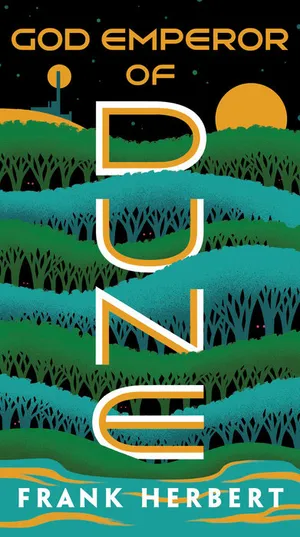
We start the novel witnessing chase of group of people by weird wolves in a forest. And this is Arrakis. From the first moment it is clear that things changed quite a lot around. There’s only one desert left on Arrakis. Around 3500 years passed since the events of previous novel. Somehow Leto II, son of Paul, one of the twins, survived. His symbiosis with sandtrouts from the end of “Children of Dune” evolved and he became part sandworm, part human hybrid. I had fun time trying to imagine human corpus sticking out of sandworm body with declining human limbs.
Leto II became millenia old tyrant of humankind Empire. Old factions of Empire, like Bene Gesserit and Tleilaxu, still function, but are supressed. There are interesting changes to the universe, due to Leto’s decrees. Lasguns (laser guns) started to be used in fight again due to ban on shields by Leto, making melee weapons obsolete again. Training mentats were banned as well, but there are still some trained. It seems that Leto’s tyranny led to peaceful, but very stagnant human universe. And that was apparently the point. I found it interesting that most of human settlements became more village-like, with usually one or two bigger cities per planet. There is scarcity of spice, because sandworms died out, except whatever exists as symbiosis with Leto. Due to that, space travel became rare, most humans don’t travel and planets are kept in near medieval level of technology.
Most of the book consists of Leto’s discussions with his favorite humans or his own thoughts and monologues. It could sound unappealing, but actually this novel was weirdly attractive for me. Leto uses his ancestral memories to design plan for survival of humanity, his Golden Path. He is breeding generations of Atrydes for his own reasons, all being descendants of his twin sister. One of them is Moneo, he was rebel once, but became his loyal servant. His daughter, Siona, is rebel now. She and her group was the ones who run away through the forest at the start of the novel after their heist. Leto is aware of her plotting, but he indulges her. There is something mysterious about her that is not visible at the first sight and Leto has big plans for her.
Beyond Leto and Atrydes descendants, important character is Duncan Idaho. Or rather I should use plural. Leto brought back multiple gholas of Duncan Idaho, one at the time, some of them he killed himself when Duncan started to rebel. I admit that I thought that Hayt—Duncan Idaho ghola from “Dune Messiah” and “Children of Dune”—was original body revived after death. I thought that’s the idea of ghola and that’s why they can unlock their memories from original life due to extreme trauma. But ghola is just Dune universe name of clone, I don’t really see what’s the difference, beyond that gholas are created after the death of original. But because Dune series already leans heavily on the concept of genetic memory, they can access memories due to that and not as I thought, because they use original brain that went to clinical death phase. I wonder why Duncan Idaho. In a way, it is somehow justifiable inside the story that he was the first one who regained his memories, Tleilaxu had access to his DNA. But from meta-level I feel that among servants of Atrydes from the first “Dune” there were more memorable characters for me, like Gurney Halleck.
The novel can seem to be quite uneventful, but as usual in the series, there’s some conspiracy, something lurking in the background that will unravel at the final. I couldn’t help, but find it funny that part of the plan to remove Leto was to find girl so attractive that he couldn’t resist her. Despite him being so far into his transformation that he’s barely human and as some people inside the story itself pointed out, he doesn’t even have necessary parts for intercourse anymore.
The central ideological core of the novel is Golden Path. Growing understanding of what is Leto’s plan for humanity is one of the biggest pleasures of this novel. As far as I could discern what it consists of, it has two main parts. First ingredient is “the lesson that humanity will never forget”. That lesson would be something like danger of absolute tyranny, but also that people’s stated desire of peace and stability is not something that humanity really wants or should want. You see, our God Emperor, big sandworm human with his ancestral memory and prescient abilities figured out that so it has to be true. I don’t really believe that negative example could teach society distrust towards authorities. It seems that there is message in this novel, but in the cycle as well, that humans inevitable cling to the authority. Leto’s message then wouldn’t even try to introduce some principled anarchy and avoid any authority into the future. Rather, it would warn against too much concentrated authority. My stance on that is that negative example doesn’t work on its own, you have to establish some cultural or institutional practices that avoid first signs of authority in its early manifestations.
As for the second part of the message, that peace and stability leads to stagnation and that humans deep down don’t want them, even if they state otherwise. This is something that taps into some arguments that I heard throughout my life and I don’t agree with them as well. There is some familial relationship between this argument and all that claims that war leads to progress more than peace.
Second ingredient, if I understood correctly, is less ideological and more for setting up certain material conditions that would help people to avoid extinction. Dune / Arrakis was the only source of the spice, psychotropic necessary for faster than light space travel, produced by sandworms living there. Leto finished project of terraformation and sandworms died out, beside whatever lived through symbiosis with him. He monopolised diminishing supply of the spice and occasionally destroyed storages of it hoarded by some weakening fractions of the Empire. Eventually it led to less space travel overall and aforementioned stagnation. The point was to completely cut humanity from the spice, but by death, Leto expected he will give rise eventually to new generation of sandworms and new spice. But before it will happen, humanity will be cut off from each other and disperse. Instead of one humanity in one Empire, basically one culture, what we saw since the first “Dune”, which we know existed for millenia, will proliferate into diverse, separated islands of humanity in the cosmos, until spice will be back and humanity could rejoin again.
If I’m right about what Golden Path is with my two ingredients interpretation, then I can say that I’m more sympathetic towards second ingredient. It is more speculative though and less applicable to our normal contemporary situation and more specific to Dune universe, but there could be set parallels with some arguments for space colonisation. All the talk about “not putting all your eggs in one basket”. But even then, it is more long scale speculation and not thesis about human nature.
Nonetheless, it sets up interesting new situation for the sequels. “God Emperor of Dune” is weird book. Definitely the weirdest from the cycle so far. But this weirdness is its advantage. I found it more interesting than the first two sequels, but I can’t say that it approximates original “Dune”.