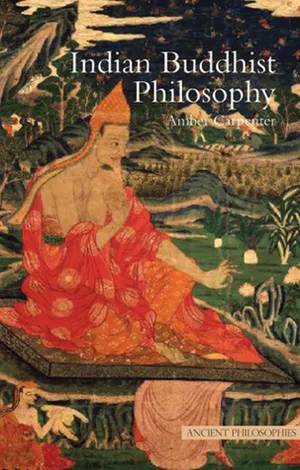
Recently I read “Classical Indian Philosophy” by J.N. Mohanty and then, to follow one of threads, “The Jains” by Paul Dundas. But it is “Indian Buddhist Philosophy” by Amber Carpenter that really feels like proper (non-fiction) sequel. It shares with it intended audience — those already somewhat familiar with Western philosophical terminology. It is also firmly focused on philosophy, it doesn’t elaborate on religious and anthropologist aspects of Buddhism. Although I knew a little bit more about Buddhism than Jainism, it was still not a lot.
One of the most interesting aspects of this book was its flow and its presentation of the subject. I feel it’s not easy to explain why I had impression it’s quite unique, because when I try to articulate it in my head it sounds as rather normal logical exposition. But let me try. It is book about history of philosophy, but it doesn’t present it chronologically or directly through schools of thought or not even by topics like epistemology, ethics, metaphysics etc. Ideas flow naturally, whenever I had some issue or question the book always predicted that and raises the same question in organic discursive manner. Then only it brings what various Indian Buddhist thinkers brought to the table which can help us resolve those questions. I don’t think it is accident, because the author stated at the beginning that they want to use Buddhist philosophy to our own thinking and presents it as relevant today, not collections of old, dusty ideas. It isn’t afraid to infuse authorial voice and doesn’t speak about Indian Buddhist philosophy from distant vantage point, but still retains academic rigour. It is written in such a way that it’s hard for me to categorize it among typical philosophical or history of philosophy books.
I said that it doesn’t follow chronological exposition or go from school of thought to another, but it is not exactly true. I wanted to point how it feels to read this book, but somehow it just happens that we start from early philosophical schools or thinkers and progress organically and logically further along the history. This impression that I had about the book changes in later section which directly speaks about developments of Indian Buddhist philosophy in sixth and seventh CE. It feels more like proper history of philosophy book, it is still engaging to read, but feel like proper historical account.
Appropriately in the middle (because it’s foundation of “Middle Way” school) of the book is exposition of Nagarjuna’s ideas of emptiness. For me it was probably the most interesting part of the book. It felt really convincing and I think Nagarjuna’s ideas about emptiness and dependent origination are correct. Perhaps inappropriate to use such desire-infused language in this context, but that doctrine feels intellectually satisfying for me. Of course, one thing is to be intellectually convinced by argument and another to really deeply embrace the idea to its core. The latter could perhaps be achieved through meditation and thoughtful Buddhist practice only.
It’s worth to point in this moment that I didn’t learn much about meditation from this book. I could sense implicit presence of meditation throughout, but rarely it was espoused explicitly how the ideas relate to meditation practice and how and if different schools and practitioners had different relationship to it.
For me it was amazing introduction to Indian Buddhist philosophy and I have many, many new intellectual threads to follow into the future.