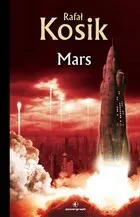
It was interesting experience to read this book just after “A City on Mars”. Science fiction about Mars colonisation just after non-fiction all about how manned space exploration and colonisation is not a good idea. I already read few works of Rafał Kosik, I liked most of them, but with some reservations. I learned only after finishing that “Mars” is his debut novel, which makes sense looking at the novel from the hindsight.
The story is set in three time periods. First is only brief prologue to the rest of the novel, setting up Mars for colonisation in 2040. Next two are set 260 and 300 years after that. During first of those periods, Mars is already partially terraformed and people are able to live on its surface and breath air. It is not so promising though, because there was some overshoot in terraformation and Mars is too hot than expected. It is too dry and vegetation didn’t take root. At this time only desperate people seem to come to Mars and one such person is one of our main characters. He looks for any job and eventually entangle himself with political machinations. There is certain recognition among scientists and ecologists that not everything went right with terraformation, but political forces dismiss it for more immediate interests. We see conflict and important politician-ecologist decides on doing in secret something dangerous, but necessary for Mars colony survival.
The last time period takes place in aftermath. Aforementioned politician-scientists was vindicated by history. His approach, if accepted among political class, would help Mars colony survive, but what he done still wasn’t enough. Terraforming project is dying and now people are desperate to leave the planet. We follow in this period character which we met before as a child. Back then he had this seemingly impossible dream of being archeologist. On a planet without history. But it is clear that in this dream there is clue of what we could expect in the last part of the book.
The novel gives us political thriller revolving around environment that seems almost too close, like clear metaphor for our times and our climate change. There is also some ideas about the past. If I would want to judge the book from hard science fiction lens, I could find issues with terraformation depiction and even more about that ideas of the past, but I swallowed more dubious ideas for science fiction. Overall it is very pessimistic about political ability to see in long scale, which is also damning for space colonialism.
The characters didn’t feel very interesting, but they were well placed to move the plot at least. It was possible to feel some sympathy to them, but I felt the author needed some work on characterization. Similarly, the story had a lot of action going on and some ideas for itself, but something didn’t click to be properly interesting. Still, there is some interesting kernel somewhere there and I could be willing to cautiously recommend for people who like more classic in style science fiction or other works of the author.