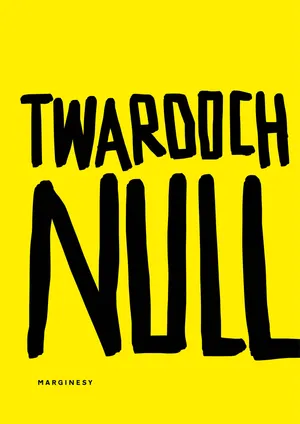
This book reached me as a gift at the time of my reconvalescence. It doesn’t fit particularly into any category that I was reading recently. Which are all things India related on one hand and speculative fiction on another, maybe with small dose of science. I only vaguely knew that Szczepan Twardoch was starting career with speculative fiction before completely forking into mainstream literature. No blurb and minimalistic cover didn’t help with establishing any expectations either.
The story throws us into titular “Null”, no man’s land at the frontier of Ukraine-Russia war. Our protagonist, called Horse, is stuck in place that overwhelm him with its pointlessness. He is volunteer on this war on Ukrainian side. Although he has some Ukrainian roots through his grandfather, for all intents and purposes, he is Polish. His father brought him to integrate fully as Polish citizen, he didn’t know Ukrainian or Russian before joining the war. He sits in provisional shelter with Ukrainian soldier from obligatory recruitment. In this context he recollects decisions and events that brought him here.
Overall the story radiates with bleakness. It casts the impression that there’s not much hope left at this war. It doesn’t seem that there’s end of it in sight, and even if there would be, it’s not clear what will be the state of the country in it. But bleakness doesn’t end with prospects for the future. It depicts sorry state of Ukrainian forces which in this depiction seems far from proper, professional army. Things are hanging together like connected throught ducktape. General recruitment soldiers barely follow orders. Army doesn’t provide anything for volunteers and relies on their own equipment. People move through position and rank through personal connections. Everything feels ad-hoc, without any wider plan.
The narration paints in the most positive light the people who take part in this war since its beginning in 2014, rather than joining through force in general recruitment. It tries to understand their flaws in wider context and they become almost like tragic heroes. They don’t have anything to return to after the war, if there is any after for them. They are shaped too much by war already and couldn’t find themselves in peace times. General recruitment soldiers are depicted as passive, cowardly and almost useless. They are animalistic, instinctively cowardly. Despite that, the novel gives a lot of hints that it’s perspective filter of protagonist, not objective depiction of reality. Especially events at the end showcase that his negative judgment of them could be wrong.
We view the story through this filter, but there is enough raw descriptions that provides room for nuance and reader’s own interpretations. Maybe there’s still some hope in this war. Maybe people who joined that war forcefully don’t deserve such judgment.
One of the most interesting aspect of the book is its linguistic side. The novel uses rare second-person narrative. Meaning someone is talking to protagonist about his story and his thoughts. For me it was clear though that it’s just the way protagonist talks with himself. At the end there was some confusing part that suggests that someone else is narrating all this, but if I understood it correctly, it was just main character’s imagination and his wishful thinking.
Language of the novel itself is Polish, but it is effortlessly infused with Ukrainian words, especially relating to military. The novel doesn’t give us much help at start and we are thrown deep into this language. It rarely gives us direct explanation of some unfamiliar words, we need to use context clues to understand meaning of them. Despite that, it was easy for me to pick meanings along the way, through experience with speculative fiction and its creative use of language.
It is hard read, mostly due to its content matter, but it is written in engaging way. It’s hard for me to assess accuracy of the novel with depicting the war. I followed it mostly through geopolitical news, rather than comparable literature, either novels or journals, written by Ukrainians. But my impression was that maybe it could depict Ukrainian side in not exactly positive light, but its sympathies are firmly with them.