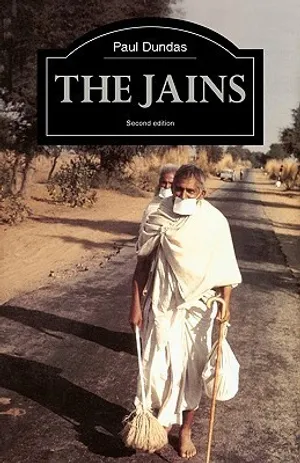
I didn’t know much about Jains before. There were some scattered pieces that I knew. Primarily, their extreme dedication to ahimsa (nonviolence), something that they are known from the most around the world. I also read the tear-jerking account of sallekhana (voluntary fasting to death) of young Jain nun from the book “Nine Lives” by William Dalrymple. The most of those pieces arrived to me through reading about Indian philosophy. I started to read this book directly after [[Classical Indian Philosophy - J.N. Mohanty]]. I was looking for a book that would give me necessary context and then follow up philosophical threads that piqued my curiosity.
This book paints comprehensive picture of Jain history, customs, sectarian divisions, complicated fates of scriptures, elaborate and unique cosmology, ascetic and lay followers lives. It was fascinating to read about so different and distinct social, religious and intellectual world. In fact, it affected me so much that I dreamt about sectarian histories, even though books rarely affect my dreams so directly. Although the most hitting was strive for radical ahimsa that was running through all those topics. How it penetrates their behavior and customs, even on minuscule levels.
It didn’t really give me much more material that brought me to this book in the first place, namely philosophy. There was some exposition of epistemology, like “manypointedness” and logic. Little account of ontology too and comparison to different religions. But the book wasn’t focused on that. What I was surprised about the most which is somehow attached to philosophical topics was very unique cosmology of Jains. It didn’t resemble anything that I’m familiar with.
It’s not secret that I’m deeply fascinated by India and I swallow books and movies about and from India with omnivore appetite. I try to read widely, to cover as much diversity of topics and cultures as I can. This is another building block of the picture of India that I try to make in my mind. However, Jain religion touches to one other thing dear to my heart, ethics of veganism.
On one hand, I know that many western vegans would dismiss Jain approaches due to the fact that most of the Jains today consume dairy. But this would be premature in my opinion. Jains historically taken huge pains to care about even the smallest living beings like insects. From those concerns come such iconic aspects of Jain ascetic as brush that prevents from stepping on insects or mouth-shield that protects from accidentally swallowing them. There’s more customs like that developed in Jain community, or more particularly in their ascetic part. We can learn a lot and challenge ourselves through looking at their ways too.
The book have been written over 20 years ago so the chapter on modern developments didn’t really cover such topics like veganism or environmentalism which started to circulate in mainstream western discourse only recently too. What this book convinced me about is that Jain community is always changing and evolving, but constantly returning to basic tenets of their faith, to ahimsa. I believe that they will eventually reconsider eating dairy and I saw that there are already some discussions happening, as described in this article: https://www.arihantainstitute.org/blog/47-are-jains-vegan-what-do-jain-scriptures-say-about-dairy
However I want to give due justice to Jainism, I couldn’t help but compare their framework to my own, that of western veganism. I have my reservation towards utilitarianism, but vegan movement speaks in this language. Throughout the book there was clear observation that Jains put their ideal in ascetic life, but in the same time they acknowledge that it’s not possible without larger lay community that supports lifestyle of ascetic minority. In this way and the way they often reason about their actions strucks me sometimes as more virtue ethics than utilitarian logic. More concerned with personal karma and eventual metaphysical liberation than with systemic large scale welfare. If your ideal can’t be realized even in principle by population at large, I feel suspicious. In contrast, I don’t see how vegan ideal couldn’t be adopted at scale. At least in principle, there’s also that small tiny practical thing of convincing people. I put forward that reflections with some hesitations, because it’s always somehow suspicious if some other framework challenge my assumptions, but in the end I still fall back into my already established worldview.
If I can allow myself to dumb down the reflection, I would say that I think we vegans make too much handwaves about our impact on insects and other small creatures. On the other hand, Jains have blind spots towards impact on cows, perhaps because during inception of religion their plight wasn’t as clear as today.