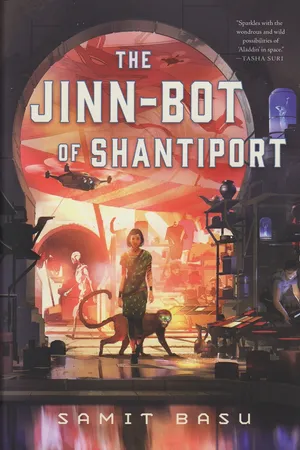
After “The Saint of Bright Doors”, written by Sri Lankan author, novel set in secondary world, but hugely mirroring Sri Lanka and to some degree India too, I read this book. It is set in far far future in some remote planet, any explicit connection to our modern times and current cultures is broken, but is still clearly inspired by India. More specifically, Shantiport feels like modern Indian city. With Samit Basu being Bengali and some hints inside the book, we could say it’s like space equivalent of modern Kolkata. At some point important center of Empire (with Kolkata it’s British Raj), nowadays far from its glory and with hangover and baggage of multiple waves of colonialism.
I loved this, obviously. We treat any reflection of modern Western culture elements as invisible and default in science fiction and we just focus on those things that are different from the present. So seeing sarees and kurtas, or variations on clearly Indian-Bengali food can strike as particularly visible. How much is it possible that those things would survive so long into unknown far future? Perhaps not big, but we don’t scrutinise same thing with Anglophone culture to the same degree. Regardless, I loved it. Those invocation of cultural idiosyncrasies were also not over the top, put there with subtlety and self-assurance, but clear enough.
Real entrypoint for the novel are its main characters and I can say that I loved them all straightaway already since the beginning. The siblings, human girl Lina who are doing shady moves apparently for some vague revolution in the future and monkey-bot Bador, dreaming about being fighter, space hero, opinionated, grumpy about being excluded from knowing the details of his sister’s plans. And there’s Moku, advanced drone “story-bot” that have been excavated by siblings and, properly for his designated function, serves as our narrator. With the unfolding of the story they grow and change their worldviews.
Moku doesn’t have memory of where he’s coming from. He is made out of advanced tech that allows him to make himself invisible for humans, bots and surveillance of Shantiport. He becomes invisible for all, but his “users”, the siblings. It allows him to be invisible, third person, objective narrator voice. At least he strives for such perspective at the beginning, but his particular voice and perspective crops up here and there, and he can be funny, in not deliberate way. Slowly he become more and more involved in the story and illusion of objective narration disappears.
Jinn-Bot didn’t appear until middle of the book. Until this point we observe the siblings, firmly rooted in Shantiport. They are defined by Shantiport and in turn, we can see it through their eyes, which makes us to care about them and the city. Well, we actually see it through Moku who learns Shantiport by following siblings.
There’s also this character Tanai, space hero. He mostly runs somewhere in the background, only sometimes entering center stage of the story. I kept thinking what other character he reminds me of. Because he is clearly troperiffic, archetypical, pulpy even, but in a good way. I end up thinking about him as something like cross between Doctor Who and Batman. That’s all I have to say about him. He’s cool.
The novel is ultimately all about difficult history, colonialism, social structures, interlocking and layered, how to change them without compromising your values, how it can be ultimately impossible. Even if you use super advanced magical jinn-bot. At the first glance, in the first part of the story it could seem it’s simply adventure romp with young woman and her monkey-bot brother, but as story progresses, we see those social undertones reverberate more strongly until they come at the front stage in the later acts.
At some points it is easy to be frustrated with main characters actions, their wishes, imagine that we could do better than them. But I think the point of the story is to show how things are always difficult, that there are no clean solutions. It doesn’t end up on murky and ultimately frustrating conclusion so common to modern superhero genre, that any attempt to change something is destined for failure and always brings more evil, before status quo can be restored. It gives hope that positive change is possible, but no one can end up with clean hands.