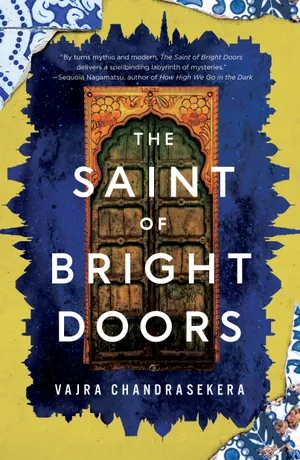
I have been waiting for this book for a long time. I heard about it from three different sources. First is general Anglo-American speculative fiction community. The book won Nebula Award and it is second most known (next to Hugo) award in English for speculative fiction. It is even bigger feat, because although there were some winners among American minorities in recent years, Vajra Chandrasekera is born in and resident of country outside of English-speaking world, specifically Sri Lanka.
Second is some leftist culture niches. I have vague impression that I saw it recommended in at least few such places, but off the top of my head I can remember particularly anarchoSF, podcast about anarchist SF or other SF works of interest for anarchists and far left.
Last but not least, I saw it mentioned in spaces about South Asian books. It is not secret that I’m deeply interested in Indian cultures and due to cultural proximity to some degree with other neighboring countries as well. There’s not that much science fiction I could find from this region and a little of which there is, it is hard to obtain where I live.
Because at some point due to seeing about it in multiple places, I taken interest in Vajra Chandrasekera’s writing and I read his blog essays and short stories scattered among many magazines and became fan just through his short form writing already. I was eager to obtain “The Saint of Bright Doors” somehow in original English, but when I read on his blog that it will be published in Polish in our market, I decided to wait and buy it. I have no problem reading in English obviously, but I want to support publishing books from this region in Poland, which is criminally underappreciated here. In such circumstances anticipation could put the expectation bar too high, especially for debut novel, but I can safely say now that it fullfiled my expectations completely.
“The Saint of Bright Doors” is very rich and layered book, so there’s multiple angles and topics that we could uncover to analyze it. Let’s start with something relatively simple, plot hooks. The novel starts with little kid Fetter’s shadow being cut away from him by his mother, in order to give him powers and train him to kill his father, messianic religious figure. Soon later we saw him moving to big city, Luriat, as a young adult, rejecting his upbringing and joining therapy group dedicated to others like him, former cult chosen ones. And there are also titular “bright doors”, strange phenomenon happening only in Luriat and its proximity.
There is a certain category of speculative fiction in my mind, for which I didn’t find completely satisfying name, but I call them tentatively “broken mirror world” genre. Another representative would be “Disco Elysium” video game. In fact, while reading often I have been reminiscing about this video game. They present secondary world, with different geographical and political names, slightly different technological developments and inserts some speculative elements, but otherwise clearly reflect our own world, often region from which authors themselves come from. We can see rough broken pieces reflecting clearly specific real life cities, cultures, political and social developments. But all the pieces taken together can’t exactly fit together, there is something odd about whole picture. The world presented feel cursed, broken in some way, but in a way we can’t exactly put our finger on what’s exactly wrong. In the same time, there’s no doubt that the mirror reflects real world’s ugliness. They generally don’t fit tradition of “dystopia” genre, because they reflect real world too much, even if in somewhat unsettling manner. The main characters, if not larger cast of characters too, are broken as much as their world. They are broken, because they live in a broken world, reflecting macrocosm in personal microcosm.
Fetter ran away from his upbringing, from his mother that trained him to kill his father. But childhood, during which he was forced to kill his relatives (as a training for ultimate assassination of his father), left him with scars that can’t be healed. He joins support group for similar “unchosen ones”, that are similarly shattered, perhaps with some grain of power they brought from their previous lives.
There’s no way to talk about the setting, the worldbuilding of this novel without pointing out that for reader like me various ingredients are equally fantastical. Real world Sri Lanka and larger South Asian reality mixes here with properly speculative elements. But for readers from outside of South Asia, both those aspects are tangled in hardly distinguishable whole. Perhaps I’m in a little bit different situation than typical western reader due to my obsession with India, but it still have that effect on me.
Luriat and its “interior”, peninsula separated by mighty mountains from the rest of the continent was created in deep past through collision of island with said larger continent (there’s actually more juicy fantastical elements to see here, but I’m leaving it out unspoiled for the reader). It is clear mirror of both insular Sri Lanka and Indian subcontinent with its defining Himalayas. Those reflections reverberate from geography up to socio-political situations. It is also post-colonial country, its colonial history embedded in the fabric of the city and life of its citizens and byzantine law and government legacy. We learn bits and pieces, enough to evoke something analogous to UK or other European colonial cultures.
There is a bold iconoclasm just in front of reader’s eyes. The key is some familiarity with Sri Lanka lore, its history and Buddhist mythology. Main character’s name, Fetter, is direct meaning of name Rāhula, the Buddha Siddhartha Gautama’s son. According to a legend, Gautama abandoned his wife and little son, because family have been obstacle to enlightenment (“fetter” is old fashioned word that could be understand as chain restrains or generally obstacle). It is, as much as possible a direct slap to the face of Sinhalese Buddhist majoritarian politics that ravaged Sri Lankan minorities for decades. There is even play on various denominations of Buddhism. High and Low Paths are, of course, Mahayana (literally meaning “great vehicle”) and Theravada (literally “elders’ doctrine”, but called “lower vehicle” by first ones) respectively.
The main motif of the novel, at least as I see it, is history and how it is told, retold and through this retellings changed. I know how contentious history is in India, to the level unimaginable for people from my country. In every country there is some dominant history interpretation, but I think nothing holds a candle to how it is in this region of the world. Long-running political controversies can be sparked through ancient archeological sites. It is as much true about India (Indus Valley civilization, Keeladi) as about Sri Lanka (monks destroying evidence of ancient Tamil presence on the island). Beyond that macrohistory, important in the novel is also microhistory of family and generational trauma.
I love digging into fully realized settings full of interesting ideas and that novel has plenty of them. The most obvious here are titular “bright doors”. It is phenomenon that occurs only in Luriat and its close proximity. Any regular doors with certain characteristics turn into mysterious, always-closed “bright doors”. Around them grew whole scientific discipline. It reminds me Stanisław Lem’s “Solaris” with his fictional solaristic discipline and other of his writings. From the author’s blog I know that he is a fan of Lem, so maybe it is not accident. Another comparison could be “Disco Elysium” radio computers and other oddities. I guess it is accidental, but since I already compared those two works I found it suitable.
Particularly curious element of the setting is its “utopian” elements. Every citizen of Luriat, including fresh arrivals, get his own apartment and allowance that is basically what we call UBI (interestingly, also official email). They have to work only to provide some luxuries. It’s hard not to put “utopian” here in scare quotes, since its embedded in such an otherwise terrifying environment. Religious fundamentalists, genocides, communal violence directed by militant monks, semi-permanent immigration centers, pandemic (the book has been written during COVID pandemic), complicated racial and caste hierarchies. But it is important to remember what I constantly highlighted, it’s just our own world in a mirror.
I read this novel in Polish translation. Sometimes I can be wary about changes to the meaning of original titles, because Poland has hit and miss tradition of rendering titles. But here it has been translated to “Święty od papuzich drzwi” which in back-translation means “The Saint of parrot doors”. This is one of this cases when I feel translation enriches. “Parrot doors” is evokative and brings unique flavor.
My conclusion is that anyone interested in ambitious and weird speculative fiction should grab this book at the first opportunity. Perhaps it could surprise and confuse some readers, it stretches genre expectations and doesn’t try to slow down to explain its cultural context. But for me at least, those are its strongest characteristics.
I’m not big believer in spoilers, but I try not to directly talk about things that occur later on in the stories I review. If I feel the urge to talk about them, I refer to them more vaguely. But there are some works when even I feel that it would be bad move not to warn about spoiler. I will speak about something from the end of the novel more vaguely here, but if you’re afraid of the spoiler just skip the next paragraph.
At the end of the novel we learn who narrates and who is hidden protagonist of the story. Until some point, we didn’t even have a reason to believe that narration is anything other than impersonal omniscient third person narration. And yet, there is big surprise for us. I will say something about translation here too, about name “Fetter”. Although “Wrzeciądz” in Polish translation is quite good translation as far as I can tell, it retains some archaic and obscure vibe of it, sounding plausible enough as a name. Unfortunately, it loses duality with the name of “hidden protagonist” and I caught out this only when I read summary in English.