My recent lectures make up natural thematic progression in my mind — perhaps not particularly surprising, because I deliberately chose them so — and I can’t avoid comparison to my immediately preceding lecture, “Indian Buddhist Philosophy” by Amber Carpenter. Even though they don’t have that much common in terms of goals and topics, except both being about Buddhism.
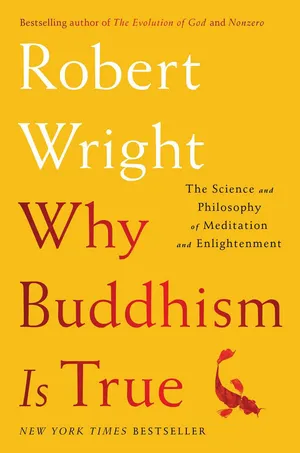
I have somewhat mixed feelings about “Why Buddhism Is True”. After finishing the book, I think the idea behind it is to elucidate authors reflections on connections between evolutionary psychology and Buddhism and especially its meditative practices. On the face value it seems interesting and I would be all for it, but somehow author’s execution is lacking for me. I learned few interesting things from it and I align with his many views. His interpretation of certain Buddhist teachings in light of evolutionary psychology resonate with me and intuitively makes sense. What went wrong then to warrant mixed feelings?
It wasn’t a favor to this book to read it directly after Amber Carpenter’s “Indian Buddhist Philosophy”, because “Why Buddhism Is True” touches ideas of Buddhist philosophy only in its most fundamental teachings. It doesn’t go particularly far enough. To be fair to Robert Wright, he explicitly states that he won’t be going deep to intricacies of Buddhist philosophy. He focuses more on naturalistic interpretation of basic teachings in light of evolutionary psychology.
I had little problem with lack of discussion of replication crisis and various criticisms of evolutionary psychology. Although certain mentioned mechanisms seemed convincing and I bet are correct, like our craving for sweet or salty food due to scarcity of it in our ancestral environment, I was unsure how much I could trust any given examples. Similarly, Wright’s explanations and interpretation lacked coherence or detail. It is sometimes hard to tell what are his claims, he meanders here and there. At some point he even conflates conflicting ideas from Buddhism and Hinduism, although I grant him some slack here, because I feel where is he coming from here.
When I reviewed Amber Carpenter’s book, I praised distinctive “authorial voice”, so it could feel weird, but here I felt that in this book there is just too much of author himself. In fact, the book is full of personal anecdotes. To such degree that often the book feels like personal blog rather than non-fiction book about certain subject. We often get descriptions from his experiences at mindfulness Vipassana retreat that he attended. We get a lot of quotations from people he met. It wouldn’t be negative in smaller amount, but it feels like his personal experiences and acquaintances get too much space in comparison to external sources. I didn’t find particularly cute his anecdotes about guy who snored while he tried to meditate. This book is full of such anecdotes.
There is still value in this book, despite my criticism. There’s multiple interesting things about evolutionary psychology, naturalistic interpretations of Buddhism, personal accounts of beginner practitioner of mindfulness meditation. I’m thinking more about how to realize that plans and find time for Vipassana retreat.
PS There is something ironic in using language imbued with metaphors relating to desires and satisfaction while reviewing books about Buddhism. I say here about phrases like “I have mixed feelings” or indeed even words like “I” or “my”. Whenever I caught myself on that, my first instict is to rephrase them. But often enough, it would be very hard to pull off and probably end up sounding artificial. Then I remember about concept of “conventional reality” and that Buddhists acknowledge that we can’t use everyday language and avoid such phrases.